In 1855, Jefferson Davis — then Secretary of War, Mississippi slaveholder, and future President of the Confederacy — ordered sculptor Thomas Crawford to remove the liberty cap from the figure that would crown the United States Capitol dome. The cap was the pileus: the soft felt cap placed on the head of an enslaved person at the moment of manumission in Roman antiquity, a symbol so freighted with the meaning of emancipation that Davis understood it immediately and refused it immediately. His stated reason: "Americans were born free." The crested eagle helmet that replaced it remains on the dome today. Freedom, as installed, wears a suppression.
Pileus is a photographic and sculptural project that names what was removed and begins to return it. It is the direct companion and descendant of Pocahontas Revised, Second Edition (2026) — eight color analog photographs shot inside the Capitol rotunda on Lomography 800 CN film, tracing the iconographic program of colonial encounter, forged diplomacy, dispossession, and orchestrated surrender that decorates the interior of the building Davis helped to build. Where Pocahontas Revised maps the existing iconographic wound, Pileus proposes the object that was prevented from existing.
The pileus version of Freedom was never built at monumental scale. Crawford made small clay maquettes showing the design; Davis rejected them. What was cast in bronze and installed 288 feet above the Capitol floor was always the revised, helmeted figure. The only full-scale built version of Pileus Freedom exists in marble on the Senate wing's east pediment — the Progress of Civilization sculptural group (Crawford, 1863), where the sculptor retained the liberty cap in stone even after Davis forced the substitution on the dome. The pediment figure is the only monument to what was refused.
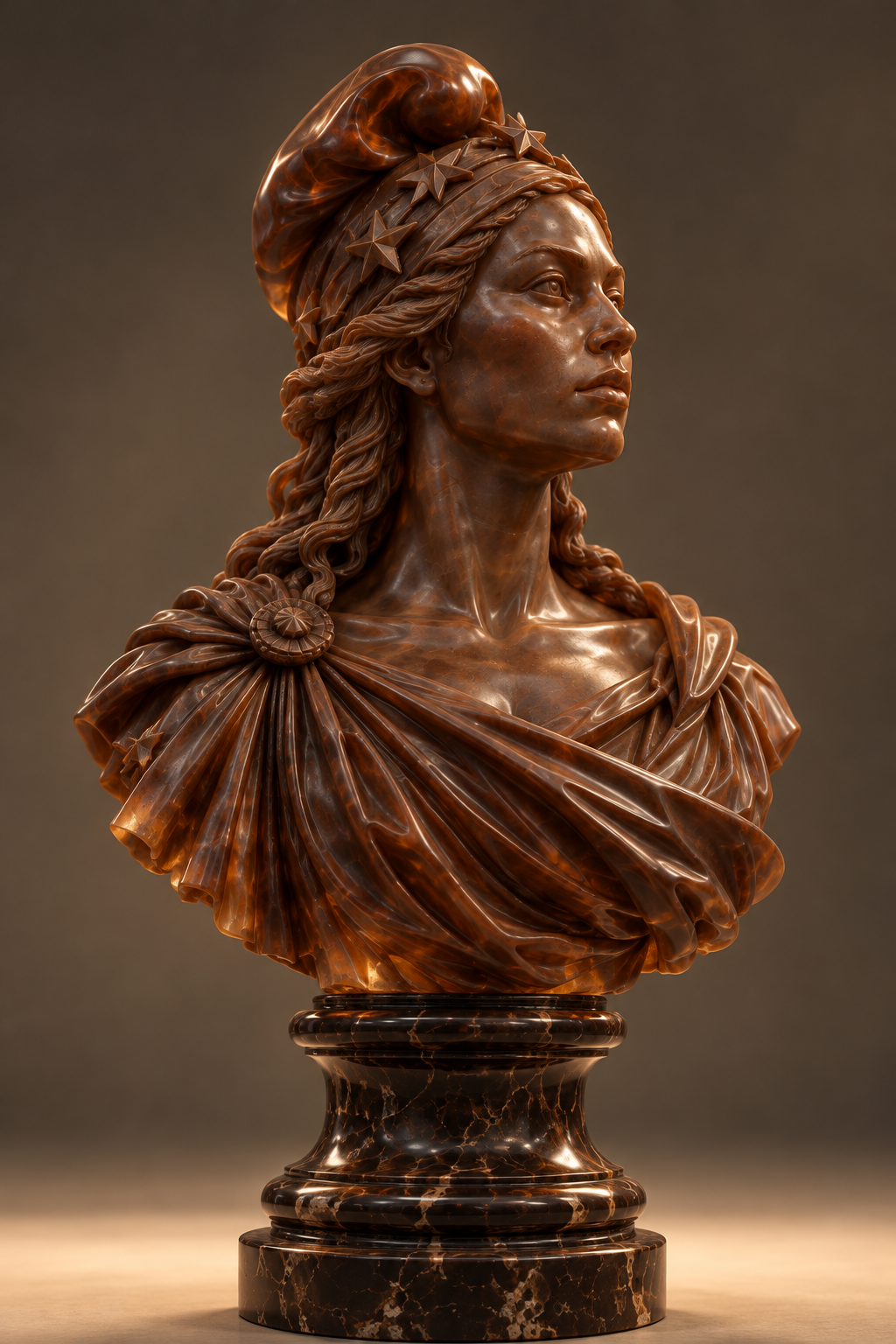
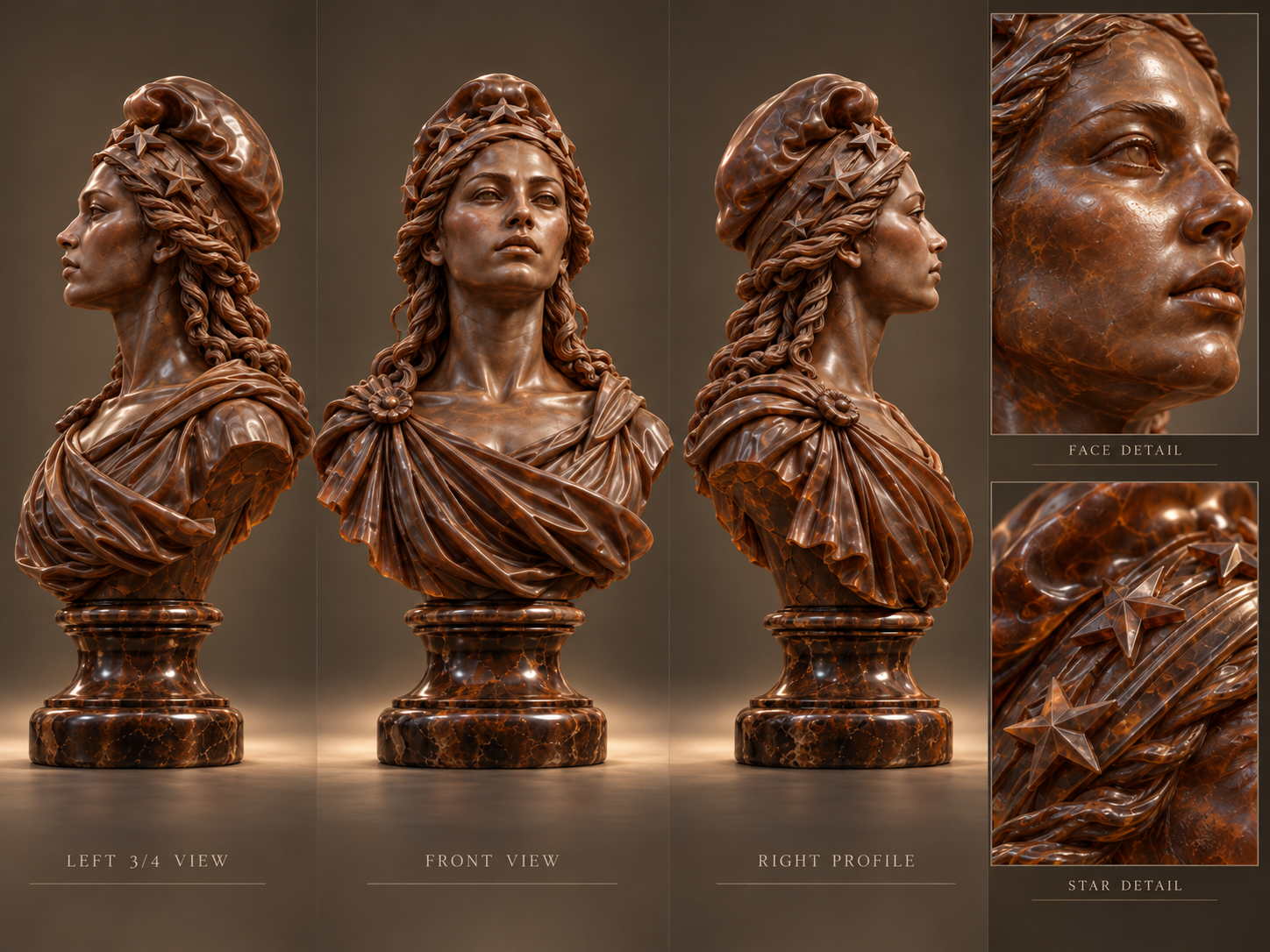
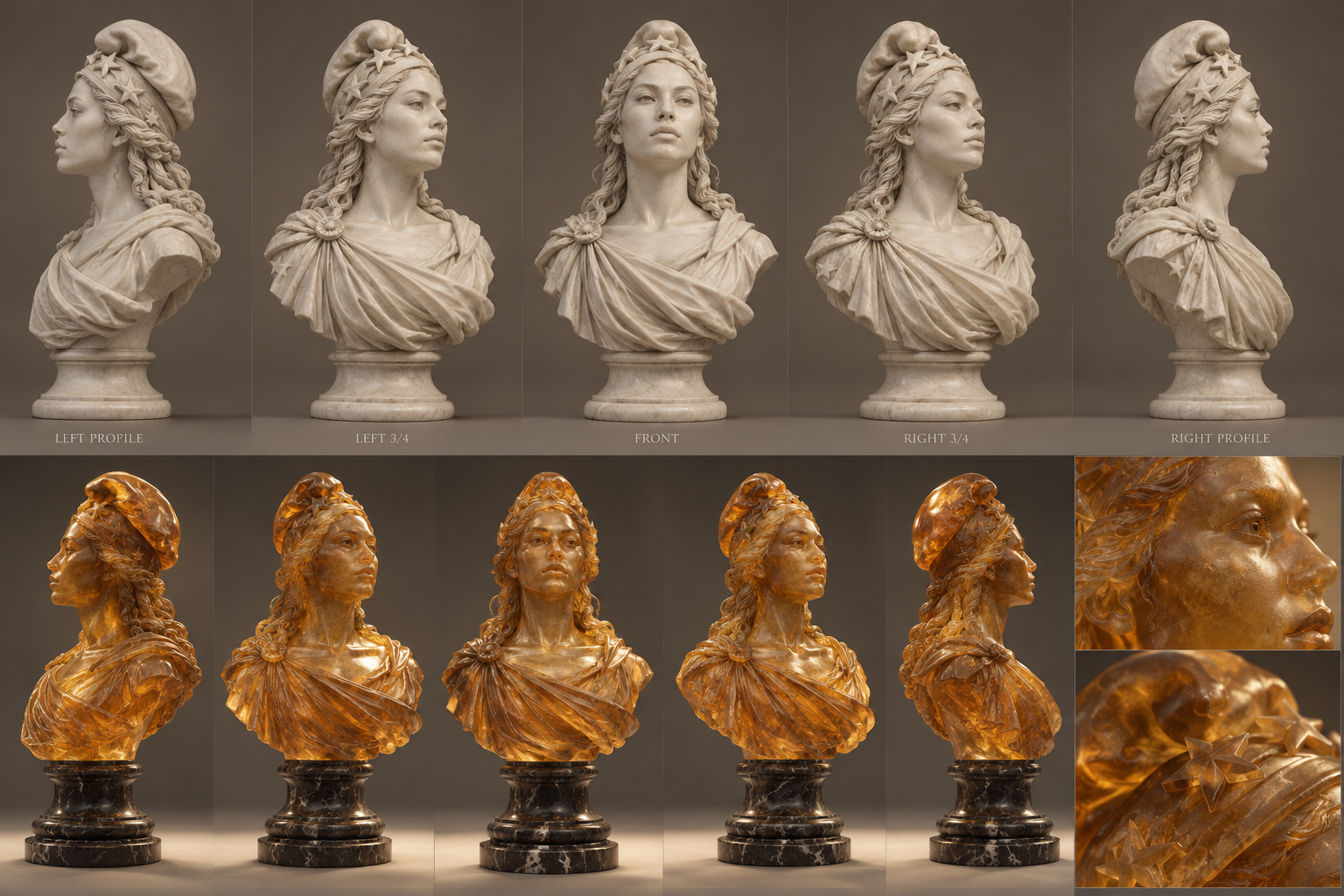
This project will fabricate, for the first time, a bust of Pileus Freedom at dome-head scale — approximately 2.5 to 3 feet from chin to crown, the proportional size of the dome figure's head. Using photographic scans of various trans women of color, including the artist, the sculptural Freedom replicas will bear the faces of real women to challenge and haunt the abstraction of the archive, which made figures like Pocahontas perform the role of founding mother to a nation desperate to counterfeit its own grand mythology.
The Disney film does this most nakedly — she's perpetually the knowing, graceful mediator, never a child, never an elder, never anything before or after the encounter. The encounter is her entire existence.
But the historical Pocahontas was approximately ten or eleven years old when John Smith arrived. She was a child. The "encounter" that American mythology celebrates — the saving, the mediation, the diplomatic femininity — was extracted from a child's body. And then she was captured, held for ransom, converted, renamed Rebecca, married to Rolfe, taken to England, and died at 21 having never been permitted to return home. There is no after. The archive closes on her as useful.
Unchilding names what the allegory requires: it needs her to have never been a child, because a child cannot consent to become a symbol. The Baptist painting in frame 8 — where it reads like a funeral, a medical examiner's room, and bridal theatre simultaneously — is doing exactly this. It depicts a young woman kneeling in white, surrounded by men, being remade. The white is the baptismal erasure. Rebecca is being installed where Amonute was.
The allegorization of Pocahontas is the founding gesture of US national identity. She is America as symbol because she could be made to absorb the violence of the encounter and return it as gift, as grace, as welcome. The US needs her frozen, needs her un-childed, needs her perpetually in the posture of offering — which is frame 7, the corn, personhood as host.
Future iterations of the sculptural work and research at the National Archives, Library of Congress, and other major U.S. institutions may incorporate and/or result in lumen prints, composites, and collages made from archival documents recovered during primary source research: the August 2, 1855 letter from Davis to Meigs referencing Crawford and Capitol sculpture; Philip Reid's pay stub held at the Architect of the Capitol; and the federal bounty payment records for the capture of an enslaved woman named Cora, logged in the same Treasury ledger as the payments for Freedom's bronze casting.
The Capitol is an allegorical machine that produces national identity by evacuating people and replacing them with symbols. The project works against that machine in two simultaneous directions — recovering the particularity of real people the archive almost erased (Cora, Philip Reid), and re-particularizing the allegorical figure with faces the symbol was never designed to accommodate. The face in this local present “the now” is the disruption. Allegory requires a generic face. We gave it ours.
Cora is the project’s haunting by materializing an abandonment. She exerts a counter-force to collective American memory not by becoming a counter-allegory — she's not "the enslaved woman" as a type — but by remaining stubbornly, irrecoverably particular. She has a name. She has two dates. She has two parties who were paid to find her. That particularity is the wound in the allegorical machine, because the machine has no grammar for her. She doesn't fit into the building's iconographic program. She's not a symbol of anything. She's just Cora, who tried to run, in the same months Freedom was being cast in the same federal account.
Mythopoetics is what allows me-us to hold both moves without collapsing them: the symbolic force of the work lives in the specific, not instead of it. Cora is mythologically powerful as Cora. Not as "Enslaved Woman." Not as "Victim of Fugitive Slave Act." As the specific person whose name is in that specific ledger on those specific dates, surrounded by silence about what happened next.
The myth that forms around her arises from the incompleteness of the archive, not from an abstraction imposed from outside.